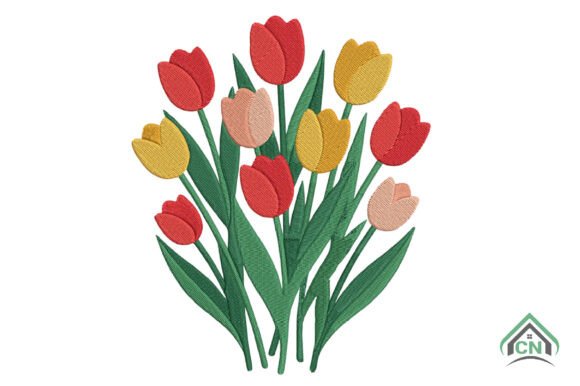
Spring Tulip Flowers Embroidery Design
A Designer’s Real-World Review for Personalized Gift Makers
As an embroidery designer who’s developed over 300 machine embroidery designs for small shops and Etsy sellers, I tested the Spring Tulip Flowers Embroidery Design across seven real customer project types: baby blankets, kitchen towels, linen pillow covers, wedding keepsake napkins, nursery wall hangings, cotton tote bags, and aprons. This isn’t a theoretical review — it’s what I’d tell my own team before approving it for production in our gift shop.
First Impression: Sweet, Seasonal, and Surprisingly Versatile
The Spring Tulip Flowers Embroidery Design delivers immediate emotional resonance — soft curves, open petals, gentle leaf movement, and balanced negative space. It feels handmade without looking amateurish, romantic without being fussy, and seasonal without feeling dated. Unlike many single-flower designs in the Single Flowers Plants category, this one avoids stiff symmetry or overly dense fill stitches. Instead, it breathes — which makes it ideal for personalized gift products where warmth and authenticity matter more than perfection.
Where It Shines: Baby Embroidery, Wedding Gifts & Everyday Keepsakes
This design is especially strong for baby embroidery. On a 100% cotton receiving blanket, the tulips read as tender and hopeful — not floral cliché. Paired with a monogram or birth date in a clean sans-serif satin stitch, it becomes a cherished heirloom. For wedding gifts, it elevates simple linen napkins or guest towel sets with quiet elegance — no lace overlay needed.
Small shop owners will appreciate how well it photographs. The design has natural focal points (the center bloom) and subtle texture (feathered petal edges), so even flat-lay product photos pop without heavy editing. That directly boosts buyer engagement on Etsy listings and Instagram previews.
For custom embroidery on pillow covers or totes, the scale works beautifully at 3.5"–4.5". It fits comfortably inside standard 4x4 hoops while leaving room for thoughtful placement — centered on a tote front, nestled in a corner of a tea towel, or aligned along a blanket’s hemline. And because it’s a digital embroidery file built for versatility, you can easily pair it with coordinating stems or add a custom name in complementary thread colors.
Where to Use It Thoughtfully — Not Everywhere
While charming, the Spring Tulip Flowers Embroidery Design isn’t universally forgiving. Here’s where I recommend extra care:
- Stretchy baby clothes: Avoid tight-knit onesies or ribbed cotton unless you use cutaway stabilizer and reduce stitch density manually — delicate petal outlines can distort.
- Thick, textured towels: On heavy terry cloth, test first. The design’s moderate fill coverage helps, but raised loops may mute fine details. A tear-away + cutaway combo stabilizer works best.
- Dark fabric: Light thread colors (e.g., pale pink, butter yellow) may lack contrast. Always run a printable mockup or physical sample before committing to a full batch.
- Curved surfaces: Skip baseball caps or mugs — this is a flat-surface embroidery design, not a vector for heat transfer.
- Small lettering integration: Don’t force tiny script names into the same hoop. Keep personalization separate — embroider the tulips first, then add initials nearby.
What It Adds to Your Handmade Product’s Perceived Value
Customers don’t just buy embroidery — they buy meaning, memory, and intention. The Spring Tulip Flowers Embroidery Design taps into spring’s universal symbolism: renewal, gentleness, quiet joy. That emotional layer raises perceived value instantly. A plain cotton towel becomes a “welcome home” gift for new parents. A simple pillow cover transforms into a “first apartment” present. That shift builds trust — especially for Etsy sellers and craft fair vendors — because buyers sense craftsmanship, not just decoration.
It also supports storytelling in your listings. You’re not selling “a flower design.” You’re offering “a hand-stitched welcome for baby’s first spring,” or “a timeless token for the couple who said ‘yes’ under blooming trees.” That narrative drives conversion — and repeat orders.
Essential Embroidery Notes Before You Stitch
Before using the Spring Tulip Flowers Embroidery Design on customer orders, here’s my non-negotiable checklist:
- Test on scrap fabric — match fiber content and weight to your final product.
- Confirm hoop size compatibility — verify it fits your most-used hoop without re-hooping mid-stitch.
- Review stitch density — if it feels too heavy for lightweight fabrics, adjust underlay or reduce fill density in your software.
- Choose stabilizer intentionally — lightweight cutaway for knits, tear-away for stable linens, fusible for napkins.
- Compare thread color contrast on both light and dark fabric swatches — some pastels disappear on ivory or oatmeal.
- Check small details post-stitch — especially petal tips and stem junctions — to ensure no skipped stitches or nesting issues.
- Verify commercial licensing — if you’re selling finished products (not just the file), confirm this machine embroidery design allows commercial embroidery use. When in doubt, contact the creator.
Final Thoughts for Small Business Owners
The Spring Tulip Flowers Embroidery Design isn’t flashy — and that’s its strength. In a market flooded with oversized motifs and trendy fonts, this design stands out by being quietly intentional. It invites slowness, care, and connection. For baby product creators, it adds tenderness. For wedding gift designers, it whispers tradition with modern ease. For Etsy sellers, it’s a reliable bestseller in March through June — and surprisingly popular year-round as a “fresh start” motif.
Used thoughtfully, it turns everyday items into meaningful personalized gift experiences. And that’s what keeps customers returning — not just for the tulips, but for the feeling they carry.